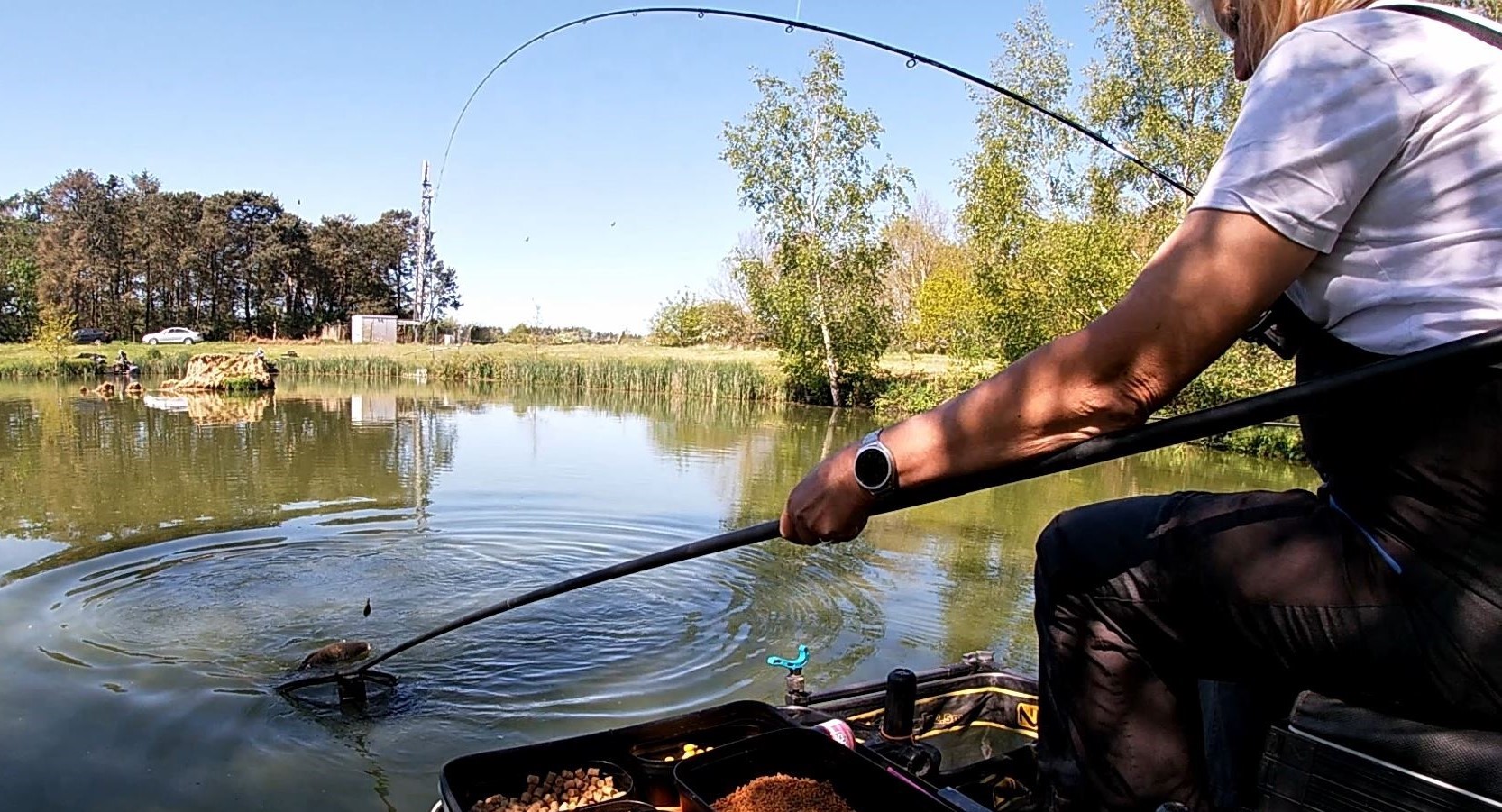

The venue was Lodge Farm Fisheries, Long Island, Peg 91.
An open match running from 10:30 through to 16:00, with conditions that looked promising on paper — warm and bright, with a slight breeze. The sort of day where fish can show up anywhere and where you feel like you should be able to build a result.
The plan going in was simple and sound:
- Feeder to the island for early carp
- Short pole line at top kit +2/3 with pellets on the deck
- Left-hand margin line for later in the match, targeting bigger fish
Nothing complicated. Just a structured, three-line approach designed to cover the water and build options as the match developed.
A Positive Start on the Feeder
The match began exactly as you’d hope.
Starting on the feeder to the island, a couple of carp came in the first 40 minutes. Nothing frantic, but steady enough to suggest there were fish in the area and that the approach was sound.
But then it slowed.
Not dramatically at first — just that subtle drop-off that makes you start asking questions.
Are they still there?
Am I feeding right?
Is this line going to die completely?
Searching for Fish — And Finding Nothing
With the feeder line fading, it was time to look elsewhere.
A switch to the short pole line with a 6mm pellet brought… nothing.
No bites.
No liners.
No signs of fish being present at all.
At the same time, a longer pole line had been fed in preparation for a shallow approach, but that too showed no signs of life.
At this stage, the match wasn’t about catching weight — it was about finding fish.
And the early signs weren’t encouraging.
Staying Disciplined
It’s very easy in this situation to start chasing the day – jumping from line to line, changing baits, and altering rigs every few minutes.
That didn’t happen here.
Instead, the approach stayed controlled:
- Keep the feeder line fed and ready
- Keep the long line ticking over
- Give the short line a proper 20-minute window
That’s important. Twenty minutes of proper fishing — not dipping in and out — is enough to tell you if something is developing.
When that time passed with no signs, the decision was clear.
Back onto the feeder.
The Only Productive Line
The response was immediate.
Signs came straight away, followed by a few more carp. Not a frenzy, but enough to confirm one thing:
The feeder line held the only catchable fish in the peg.
From that point on, the match developed into a repeating pattern:
- The feeder would produce a few fish
- It would slow down or die
- Other lines would be checked
- Nothing would happen
- Back to the feeder for another short run of bites
The margin was introduced and rested properly, but never showed any signs.
The short pole line was revisited — still lifeless.
The long line never developed.
Every indication pointed in the same direction:
There were simply no fish in pole range.
The Hard Truth of the Day
This is where fishing becomes brutally honest.
You can have the right rigs.
You can feed correctly.
You can rotate lines with perfect discipline.
But if the fish aren’t there, you’re not going to catch them.
And this was one of those pegs.
Looking Left and Right
While this was unfolding, the pegs either side were telling a completely different story.
- Peg 92 (the end peg) was catching heavily
- Peg 89 was also putting together a strong weight
Both anglers were catching across multiple lines:
- Pellet waggler
- Method feeder
- Paste line
That’s the key difference.
They didn’t just have fish — they had fish spread through the peg, feeding confidently in different areas.
That’s how matches are won.
This wasn’t a case of being one tweak away from competing.
This was a case of being on a peg where the fish simply hadn’t settled.
Managing the Situation
At that point, the match becomes about damage limitation and discipline.
The worst thing you can do is abandon the only productive line in search of something that isn’t there.
Instead, the focus stayed on:
- Maximising the feeder line when it produced
- Letting it rest when it died
- Checking other lines without committing too long
- Returning to the feeder whenever signs appeared
It’s not glamorous fishing, but it’s the right way to approach a difficult peg.
The Result
At the weigh-in:
30lb 3oz
On its own, that feels disappointing.
But context matters.
- 1st place: 135lb (Peg 92)
- 2nd place: 126lb (Peg 89)
Both from the same section.
Against that backdrop, 30lb 3oz was enough for:
3rd in section — and the default section win.
What This Match Really Teaches
It’s easy to come away from a result like this frustrated.
But strip it back, and there are some solid positives:
- The match was fished with discipline
- Lines were rotated properly
- Time was given to each approach
- The productive line was identified and used effectively
- No panic decisions
The difference wasn’t decision-making.
The difference was fish location.
Final Thoughts — Fishing Within Your Peg
There’s a saying that comes up time and time again:
“Fish the peg you’ve drawn.”
On this day, Peg 91 didn’t hold the volume of fish needed to compete for the win.
But it held enough to build a result – if you stayed patient and made the right calls.
That’s exactly what happened.
Not every match is about winning.
Some are about doing the job properly.
And this was one of those days.